

Mold Steel Grades: Choosing the Right Steel for a Mold Base
Compare C45, EN8, P20, 1.2312, 1.2738, stainless mold steels and H13. Understand which materials suit supporting plates, which belong in cores and cavities, and what to confirm before ordering.
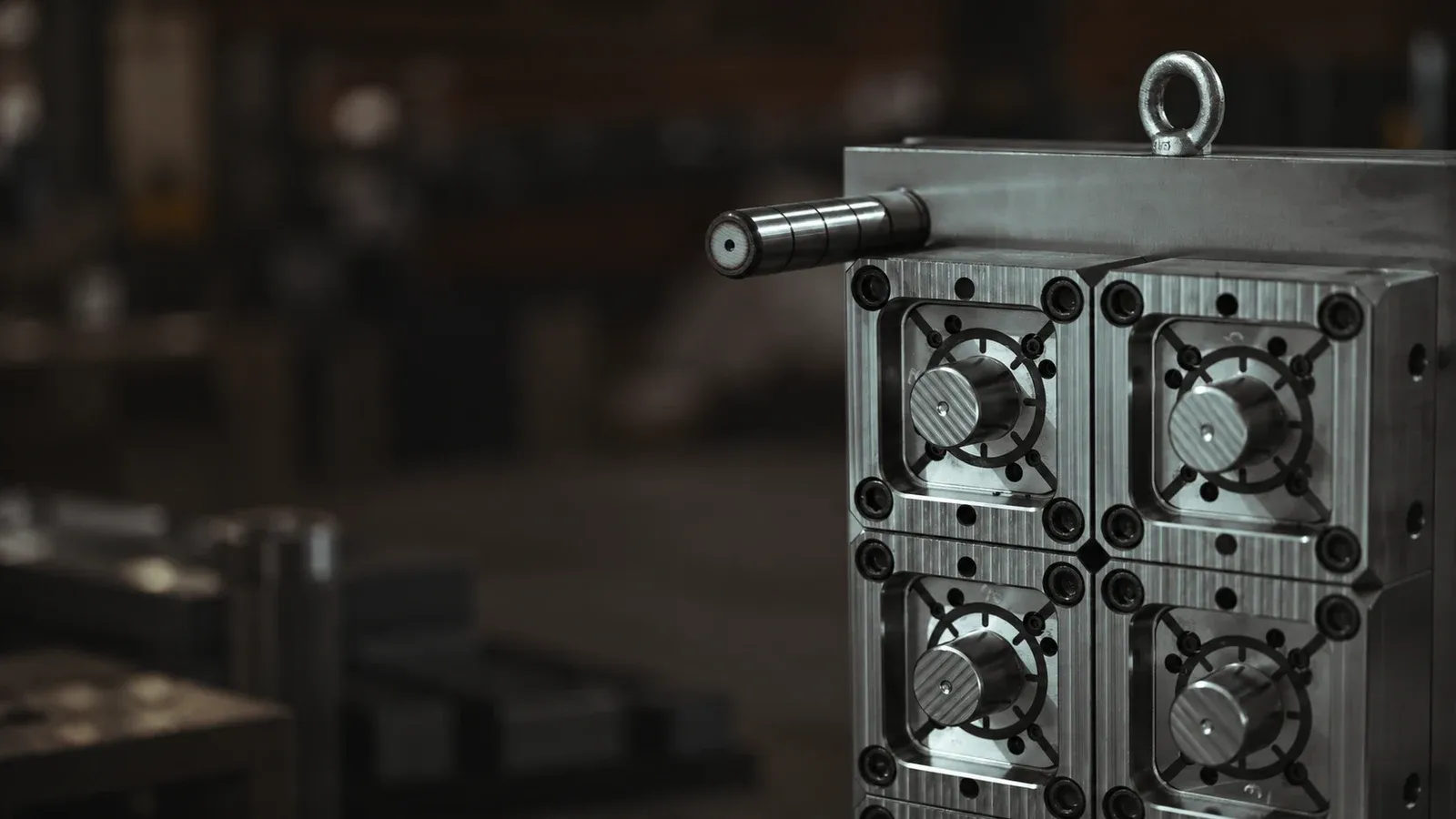
Two steel plates can look identical after grinding and still be poor substitutes for each other. One may spend its working life supporting the mold assembly. The other may form a polished product surface, carry a cooling circuit or face abrasive resin every cycle. A useful material choice starts with that difference, not the cheapest price per kilogram.
This guide compares common mold steel grades and explains where they fit in a mold base. It is a starting point for a discussion with your mold designer and supplier: the final specification should match the actual plate, operating conditions and approved drawing.
Mold base steel and cavity steel do different jobs
The mold base holds the tool together and supports its working components. Clamp plates, support plates, spacer blocks and ejector plates need the strength, machinability and stability specified for their individual duties. Cores and cavities also have to meet the demands of the plastic, the molded finish and wear at the forming surface. In some designs the cavity is machined directly into a plate; in others it sits in a separate insert. Identify which arrangement you are buying.
- Supporting plates: start by comparing the approved carbon-steel or prehardened holder-steel options.
- A plate with extensive pocketing and drilling: give machining effort and movement during machining proper attention.
- A base exposed to corrosion: investigate a corrosion-resistant holder grade.
- A core or cavity: add resin, reinforcement, polish, texture, temperature and production demands to the selection.
- Wear parts and hot-working components: assess them separately rather than applying one grade to the whole assembly.
C45 / 1.1730 and EN8: carbon-steel options
C45-type tool steel, including 1.1730 used in mold-base catalogues, is an option for unhardened supporting plates and frames where the design does not require an alloyed or corrosion-resistant steel. It is worth considering for straightforward support duties. Confirm the exact grade and delivery condition before ordering.
Do not read the name C45 as a promise of one universal delivery condition. Ask whether the plate is supplied as rolled, normalized, annealed or with another specified treatment. Also confirm the preparation and material records required for the job.
EN8 is an unalloyed medium-carbon engineering steel supplied in several forms and conditions. Check an EN8 offer against the exact material specification on the drawing. Do not automatically substitute it for C45 or 1.1730; similar applications do not make purchasing descriptions interchangeable.
P20 / 1.2311: prehardened steel for mold work
P20 is a familiar starting point for plastic-mold enquiries. The 1.2311 grade is commonly associated with this family and is offered in a prehardened condition. Its strength and suitability for polishing make it worth considering for cavity plates and inserts where the forming surface or plate duty calls for more than a basic supporting material. Confirm the delivered hardness and surface requirements for your job.
Write the exact designation into the order. A quotation that says only P20 leaves room for different variants, supply hardnesses and producer specifications. If the component will be polished or textured, tell the supplier the required result before accepting the material. Prehardened also does not mean corrosion-resistant.
1.2312 / P20+S: when machining the base matters
1.2312 is a prehardened, sulfur-alloyed mold steel. The sulfur addition helps machining, which can be useful in holder plates with substantial drilling and milling. It is an option for mold-base plates with higher strength requirements. Confirm the offered hardness, section size and machining route before ordering.
The trade-off is the surface requirement. 1.2312 is better suited to readily machined holder plates than to demanding polished or textured cavities. Discuss polishing, etching and EDM requirements before choosing it. For more demanding surfaces, compare suitable grades such as 1.2311 or 1.2738. Keep P20 and P20+S clearly identified as different material choices on the order.
1.2738 / P20+Ni: a consideration for larger sections
1.2738 is a nickel-containing prehardened mold steel, often described commercially as P20+Ni. Nickel helps achieve more uniform properties through larger sections, making this grade a consideration for larger mold components. Confirm the offered section size, hardness distribution, machinability and required surface finish for the specific plate.
1.2085 and stainless holder steels: managing corrosion
When corrosion is a concern for the base, 1.2085 is a relevant holder-steel option. It is a corrosion-resistant, prehardened grade with sulfur added for machinability. Its role is in mold-base plates and holders rather than demanding polished mold inserts. Choose the cavity material separately according to the forming surface and operating conditions.
When comparing corrosion-resistant holder steels, include cooling-water conditions, cleaning chemicals and storage exposure in the discussion. Confirm the exact designation and delivered properties for each offered material. Corrosion resistance helps reduce maintenance risks, while proper cleaning, storage and care remain necessary.
1.2083, H13 and D2: grades for different working demands
1.2083 / 420-type mold steel belongs in the discussion when a core or cavity needs corrosion resistance and a demanding surface finish. Polishability and wear resistance depend on the exact material, cleanliness and heat treatment. Confirm the full specification and treatment route rather than relying on the broad 420 description alone.
H13 / 1.2344 is a hot-work tool-steel family. Its hot strength and resistance to thermal cycling make it relevant to demanding working components, including die-casting tooling and some plastic-mold applications. Selecting H13 for an insert does not mean the clamp plates, spacers and ejector plates also need H13; their duties still govern their specifications.
D2 / 1.2379 is a cold-work tool-steel family used where wear resistance is an important part of the requirement. Its selection belongs to a different discussion from a general mold-base support plate. If a drawing calls for D2 in a particular part, keep that requirement attached to the part rather than extending it to the complete base.
How to choose the right material for your mold base
- Name the component. Mark whether it supports the assembly, holds an insert, forms the product or operates as a wear part.
- Describe the operating conditions. Include the resin and fillers where relevant, mold temperature, moisture, cooling-water exposure and expected production demand.
- Check the mechanical design. The designer should confirm plate thickness, support, pocket depth and loads; hardness alone cannot approve an assembly.
- Match the machining and finish. Tell the supplier about deep pockets, extensive drilling, EDM, polishing or texture requirements.
- Agree the supply condition. Specify delivery hardness and test scale, any later heat treatment, and the dimensions required at each stage.
- Compare the total prepared cost. Include machining, treatment, finishing, inspection and expected maintenance rather than comparing the material price alone.
For example, consider an injection mold with separate polished inserts. Its support plates, pocketed holder plates and inserts need not share one material. You could ask the designer to compare a carbon steel for the supports, a prehardened grade for the holders and a suitable polishable grade for the inserts. If corrosion becomes a concern, revisit the exposed components individually. This creates a clear specification instead of upgrading every plate without checking why.
Confirm hardness, preparation and material identity
A surface-ground plate has a prepared surface; the finish does not identify its steel grade or certify its hardness. Specify the material, delivery condition and hardness requirement separately. Confirm these details against the approved drawing and the actual material offered for your order.
- Record the full grade or approved producer designation, not just tool steel or MS.
- State whether the hardness requirement applies on delivery or after heat treatment, and name the test scale.
- Separate the blank size, machining allowance and required finished dimensions.
- Ask for the material and hardness records required by your quality plan, with traceability to the supplied pieces.
- Approve any proposed substitute before cutting or preparation starts.
Common questions about mold steel grades
Which steel is best for a mold base? There is no single answer for the whole assembly. C45-type carbon steels, prehardened grades such as 1.2312, and corrosion-resistant holder steels serve different needs. Choose by component duty and operating conditions, then confirm the drawing and supply specification.
Can mild steel be used for mold-base plates? The term mild steel is too broad to approve a precision plate. If the designer allows a particular structural steel for a component, specify that exact grade, condition and inspection requirement. Do not replace an approved C45, EN8 or alloy-steel requirement with an unspecified MS plate.
Are P20, P20+S and P20+Ni interchangeable? No automatic substitution should be made. The sulfur-containing and nickel-containing variants are selected for different priorities. Confirm the full designation, size, delivered properties and surface requirements before accepting a replacement.
Does every mold-base plate need hardening after machining? No. A prehardened plate may be machined and used in its supplied condition when that is the approved route. A component specified for later hardening needs its own treatment and finishing plan. Put the agreed sequence on the order.
Send Deulec a clear mold-base requirement
Send the mold-base size, plate list, approved grades, finished thicknesses, quantity and drawing revision. Add any hardness, material-documentation or preparation requirements and your delivery city. If the grade is still undecided, explain the component's job so the enquiry can be reviewed against the right requirements.
Use Deulec's mold-base configurator to organise your assembly and quotation request. Available materials and the final supply scope are confirmed with the quotation.
Mold Bases
Turn your requirements into a personal quotation.